Skip to content

Knowledge

What is a Hardware Implant?

The Trojan Horse in the Supply Chain

Tampered hardware can give attackers undetected access to sensitive data and IT systems, even on devices from authorized retailers. But how do such hardware implants work, and how can supply chain attacks be detected and prevented? In this article, you’ll learn about the risks involved and how hardware security testing can protect your products.

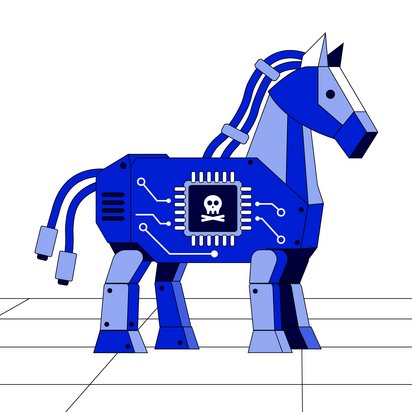
Eine symbolische Darstellung eines trojanischen Pferdes
Essen | 22 October 2026

The side channel is an unconscious self-revelation: an information system cannot help but reveal, through its power consumption or electromagnetic emissions, what it is currently processing. (More on this in the article on side-channel analysis). A hardware implant is the exact opposite of this. It is, for example, an additional component that someone deliberately inserts into a device and which, as far as possible, must not give anything away. Nor should it unintentionally emit any signals; rather, at the right moment, it must provide precisely the one piece of information that opens up the system to an attacker – or carry out precisely the one action that grants them access.

An everyday example: you buy a new lock for your front door, apparently in its original packaging and undamaged. However, nobody noticed that someone had previously opened the lock casing, fitted the lock cylinder with additional components, closed the casing again and resealed the packaging. You always use your own lock and have no idea that a stranger has access via a master key.

“Silent and Unrecognized”

The key thing about an implant is not, first and foremost, what it can do, but that it is strikingly inconspicuous. The attacker must never possess the device that you yourself will later hold in your hand. It is enough for the attacker to briefly gain access to just one of many identical devices along the device’s journey from the manufacturer to the buyer – during production, in the warehouse, at the retailer’s premises, or in the post. This is why we speak of an attack on the supply chain. In doing so, the attacker has two things that the buyer does not: time, and the opportunity to work on the very same device multiple times until the tampering is undetectable.

This need for invisibility almost naturally dictates the technical development. An implant must be tiny, as there is no space inside the device. It must manage without visible wiring, as wires would attract attention. It must match the colour and labelling of what is already on the circuit board. And it must remain inconspicuous when, for example, transmitting data externally via radio, as an antenna would be the most conspicuous component that could be fitted into such a device.

More on Cyber Security in the Supply Chain

The Ledger Case: An Implant That Reads the Seed Phrase

In early October 2026, the crypto wallet manufacturer Ledger reported that a backdoor had been discovered in a limited number of devices from the Nano X series (source). According to Ledger, around $102 million worth of cryptocurrencies was stolen via these devices. Following an analysis of the blockchain by the company Bitquery, it was found that approximately 315 accounts were affected. The cryptocurrencies stolen included Bitcoin, Ethereum, Tron and others. The affected devices were initially sold by an authorised Ledger retailer called CryptoBilis, based in Malaysia. Shortly afterwards, buyers in Germany reported having also found implants in Nano X devices they had purchased in August and, shortly afterwards, in branches of the same European electronics chain; implants were also reported in the newer Ledger Flex and Ledger Stax models.

Following an analysis, the way it works can be described as follows: an additional circuit board, an antenna, an LTE module and an eSIM were found inside the device. The implant remains completely passive until the owner activates their device for the first time and generates a random seed phrase – the password-like sequence of words used later to recover the account. The moment the wallet sends each character of this phrase to its own small display, the implant copies the character and stores it. It then transmits the phrase to the attackers via the eSIM and a nearby mobile network.

The implants have clearly been improved over several generations. Whereas initially a bundle of hand-soldered wires ran between the auxiliary circuit board and the display, later variants featured a custom-made flexible circuit board laminated flat onto the original circuit board. The latter was coated in black, soldered only at specific points, fitted with a smaller battery and had its component numbers sanded off to blend in seamlessly with the existing electronics. The corresponding antenna bears the screen-printed identification AC-A2016-NANO-V1.1; clearly a component manufactured in series. The illicit distribution channel has also been significantly optimised: whilst the first devices came almost exclusively from dubious online retailers in South-East Asia, more recent finds originated from authorised specialist retailers and retail chains.

Das Bild zeigt einen Laseraufbau im TÜVIT-Hardwarelabor hinter einer grünen Glaswand

The TÜVIT Hardware Lab

Would you like to find out more about our expertise and services relating to our state-of-the-art hardware laboratory? If so, please follow the link.

The Trezor Case: An Implant as a Replacement Part

Shortly after Ledger made a public statement, its competitor Trezor announced that it was reducing the number of its authorised retailers as a precautionary measure – whilst emphasising, however, that there was no evidence that any of its own devices had been compromised. However, back in August 2026, implants had already been reported in two Trezor devices: a Trezor Model T (purchased in 2025 via Facebook Marketplace in Canada) and a Trezor One (purchased in August 2026 from a TikTok shop). Both devices came from unauthorised third-party retailers, and Trezor no longer sells either model itself.

Technically, this is a different type of tampering. In the case of Ledger, an additional component was placed alongside the original circuitry; nothing on the device itself was altered. With Trezor, however, the attackers completely replaced the security chip with one of their own and installed a modified, fraudulent version of the Trezor software onto it. This was possible because the original Trezor software is open-source. The fake software no longer generates a random phrase; instead, it selects one of around a dozen pre-calculated phrases, all of which are known to the attacker. Because the device itself is now malfunctioning, the fake software must bypass the integrity check. In the Model T, a copy of the original software is stored on a micro-SD card soldered inside to the card slot; in the Trezor One, it is stored in the memory of the fake chip. Initially, the integrity check passes successfully against the clean original software; only then does the fake software take over.

Instead of the approximately 102 million dollars in the Ledger case, a sum of just over 50 dollars was initially debited from the Trezor One, which aroused the owner’s suspicion. Although the current Trezor Suite now detects this type of implant, the user can still continue with the transaction, which is why money was also lost in this instance.
The Cisco Case: An Implant for Two Hundred Dollars

Unlike Ledger wallets, the implant did not transmit anything at all: no eavesdropping, no radio signals – just a component that makes the device obey commands (source). The debate was sparked by a claim, as yet unconfirmed, by Bloomberg Businessweek that a spy chip the size of a grain of rice had been planted on Supermicro motherboards used by major technology firms. Apple, Amazon and Supermicro denied the claims, whilst the NSA dismissed the report as a false alarm. Security researcher Monta Elkins (FoxGuard) demonstrated what is technically possible at the CS3sthlm conference. Using a $150 soldering iron, a $40 microscope and chips costing $2 each, he modified a Cisco ASA 5505 firewall in such a way that an external attacker could gain deep control.

Technically, the procedure is considerably simpler than with Ledger wallets. A five-millimetre microcontroller, taken from a two-dollar device, is placed in an inconspicuous spot on the firewall circuit board, from where it can access the serial interface; according to Elkins, he could even have concealed it beneath one of the RF shielding plates. When the firewall is first started up, the chip identifies itself as an administrator currently working on-site, whereupon the firewall opens its password recovery function, creates a new admin account and, via this account, grants access to settings, security functions and connection protocols.

As our own Live Demo Shows: the Voltage Glitch

We demonstrated just how easily this can be shown in practice with a live demonstration at the TÜVIT Industry Meeting – IoT Cyber Security on 7 October 2026: a standard microcontroller (STM32F303), which only executes commands after a password has been entered, with a transistor acting as a switch in its power supply. A brief voltage dip at just the right moment – triggered by a pulse signal – causes the processor to simply bypass the denial response following an incorrectly entered password. Link to the slides from the live demo.

The parallel to Ledger, Trezor, and Cisco is obvious. In all three cases, the vulnerability is permanently embedded in the purchased product and lies in wait—in the case of Ledger and Cisco, as an additional component on the circuit board; in the case of Trezor, as a replaced microcontroller running its own software. However, while the live demo still requires an oscilloscope, a trigger, and a pulse signal—because the attacker must identify the right moment for the attack from the outside—a real implant detects this moment on its own.

Industry Meeting 2026: Slides for the Live Demo

What You Can do About it

Simply buying from an authorised dealer does not protect against attacks. Anyone purchasing circuit boards, modules or devices is also buying into their supply chain, and every stage – from assembly to retail – allows for substitution or alteration. This can only be verified against a specified standard. The approved components and the configuration of a product version, documented as a software bill of materials (SBOM) and hardware bill of materials (HBOM), with a reference image of the circuit board and traceability via batch and serial number. A comparison is carried out upon receipt of goods. A microscope or X-ray image is checked against the reference, along with a functional test for unusual communication and altered boot behaviour.

What the device itself reports supplements this, but is not sufficient as proof: Secure Boot verifies the software during startup, while the device attestation verifies the component’s identity and the software’s state—Ledger, for example, notes that its authenticity check does not detect physical alterations as long as the security chip remains intact. Thus, the attestation verifies the component, not the device. Conversely, the Trezor case shows that even a successful software check does not provide protection. Although the current Trezor Suite recognizes the tampered Model One as counterfeit, the user can simply continue using the device afterward. Your own software design should therefore not rely on a single code branch, software check, or assumption to restrict access to critical functions. Our live demo showed how a brief power dip is enough to skip code.

Whilst requirements for manufacturers and products are set out in BSI TR-03183, assessments in accordance with Common Criteria (CC) or IEC 62443 – which also focus on supply chains – can be crucial; the key term here is CRA compliance. Ultimately, the depth of the testing determines the level of risk.

Do you have any questions?

We're happy to help!
Timo Bartkewitz, TÜV Informationstechnik

Dr. Timo Bartkewitz

Team Lead Security Assessment and Testing